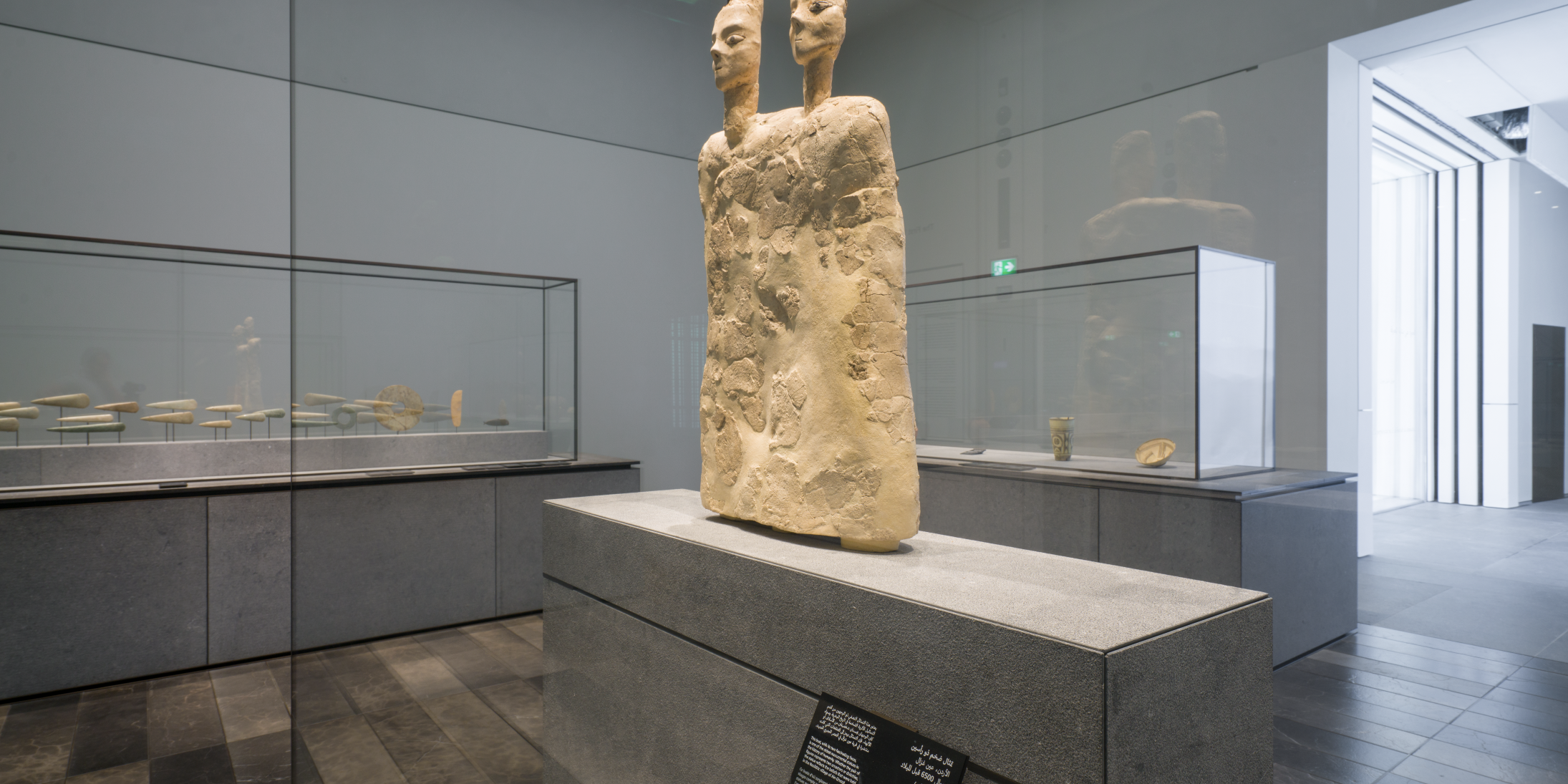
Abu Dhabi – When visitors step into the First Villages gallery to start their journey at Louvre Abu Dhabi, they are met with an arresting double gaze from humanity’s distant past. The Monumental Statue with Two Heads, unearthed in Ain Ghazal archaeological site near Amman in Jordan, is one of the oldest monumental human figures ever discovered and represents a significant moment in human history. Crafted between the 8th and 7th millennium BCE, it was a time when early societies were forming, experimenting with new materials, and creating symbols of their evolving identities.
Amna Al Zaabi, Senior Curatorial Assistant at Louvre Abu Dhabi, reveals the statue’s role in the museum’s universal narrative, discovered in a region that is cited as the cradle of civilisation. “The Ain Ghazal statue is extraordinary, not just because of its age but because of what it represents. It is a testament to the emergence of settled communities, social structures, artistic expression and new technologies,” she explains.
The museum shares the wider narrative of Saadiyat Cultural District’s seven cultural institutions that will take visitors on a journey through our world’s history and the collective cultures that unite us, all seen from the perspective of Abu Dhabi for the first time. Within this, Louvre Abu Dhabi tells stories of human creativity, meticulously curating its collections around key moments that transcend civilisations, geographies, and times.

© Department of Culture and Tourism – Abu Dhabi. Photo by Siddharth Siva
The Ain Ghazal statue sits at the threshold of this journey, illustrating the transition from nomadic life to agricultural settlements. “This period saw the rise of new social and spiritual symbols,” Al Zaabi says. “The statue gives us a glimpse into the way early humans may have perceived leadership, ancestry, or the divine.” Although, as she admits, no-one knows the statue’s exact purpose as this was a time well before the written word, so archaeologists have to use clues left behind in the sand to form their theories.
The Ain Ghazal statue is one of over 30 plaster figures, found reverently buried in two separate pits beneath abandoned dwellings in the neolithic village of Ain Ghazel, a site named for a nearby spring. This careful placement hints at ritual significance. “They weren’t simply discarded or buried with human remains,” Al Zaabi notes. “Instead, they were carefully placed under the floors of abandoned dwellings, which suggests they held immense meaning for their creators. Whether they represent ancestors, deities, or early leaders is still an open debate.”
Al Zaabi also reveals that traces of paint on some of the figures and a recess feature above the forehead where a hairpiece or headdress could have rested suggest that these statues may have been colourfully adorned and clothed. But again, this is something archaeologists and specialists can only interpret through available data and add to the statue’s enigmatic presence in Louvre Abu Dhabi.

© Department of Culture and Tourism – Abu Dhabi. Photo by Greg Garay
Beyond its artistic and symbolic importance, the Ain Ghazal statue is evidence of early technological advancements that have endured through millennia. “Lime plaster technology was a major innovation of the time,” Al Zaabi explains. “It was used for everything from flooring and wall coverings to jewellery and sculptural works like the statue.”
However, the passage of time inevitably took its toll on the artefacts. “Originally, the statues would have been created with an armature of reed bundles and bitumen to animate the eyes, but when archaeologists unearthed them in 1983 and 1985, they were fragile, with much of their structural integrity compromised,” says Al Zaabi. The painstaking task of restoration was carried out by experts at The Smithsonian Institution in Washington, D.C. and the British Museum in London, who carefully stabilised and restored the statutes—a process that lasted nearly a decade.
Despite their artistic and technological achievements, the Neolithic societies that created the Ain Ghazal statues faced environmental challenges according to Al Zaabi. “By the end of the 7th millennium BCE, we see evidence of widespread deforestation and resource depletion. This may have forced these communities to abandon their settlements and look further afield to reform and re-build.” It’s a revelation that even early civilisations had to grapple with climate change and the consequences of their environmental impact of overexploitation. Their struggles offer a sobering reflection on the sustainability issues we face today.

© Department of Culture and Tourism – Abu Dhabi. Photo by Greg Garay
Since its installation in 2017, the Ain Ghazal statue has been a prominent piece in the Louvre Abu Dhabi’s collection. On loan from Jordan’s Amman Museum, it is a testament to the museum’s commitment to fostering international partnerships. In 2022, Al Zaabi travelled to the country to speak at the International Conference for Jordanian Archaeology and History at Yarmouk University, discussing the statue’s significance and how it fits into the museum’s global narrative. “It was an also an opportunity to inform the Jordanian public of its importance in Louvre Abu Dhabi’s narrative and how it helps cement the already strong relationships between Jordan and the UAE.”
Artefacts like the Ain Ghazal statue serve as cultural bridges, linking ancient civilisations to contemporary audiences. As visitors stand before its striking, bitumen-outlined eyes, they are reminded that history is not just a series of distant events, it is a story that continues to shape our understanding of who we are. “It’s a privilege to share these stories,” declares Al Zaabi. “This statue is not just a relic; it’s a connection to the shared human experience.” Louvre Abu Dhabi’s commitment to presenting such pieces ensures that the legacy of Ain Ghazal and its creators endures, offering a timeless dialogue between past and present.